Are you looking for accurate and precise guidance on the concrete slab cost in 2025 in the USA? Yes! Then we will calculate the cost and clear all your hurdles in this authentic article. Are you ready? Just follow the expert’s instructions about concrete slab cost and work like a pro.. Whether you are looking for new home construction, industrial construction, or commercial buildings, in this article, we provide you with complete and proper guidance. We cover the complete concrete pad cost that helps you plan your project smoothly and effectively.
If you want to become a pro, then you need to know the current market prices, laws, and flaws. And with our assistance, you can easily determine your slab cost. Also, we will discuss different affecting factors and helpful information to get a precise price.
What About a Concrete Slab?
A concrete slab is a horizontal surface of poured concrete, used in commercial buildings, industrial homes, bridges, floors, basements, patios, outdoor spaces, and warehouses to support their structures. In the current era, various types of concrete slabs are used in the USA, such as suspended slab, precast slab, and on-grade slab. It is strong, durable, affordable, and long-lasting, and can bear heavy loads, and also does not need much maintenance.
Precise Estimated Cost to Install Concrete Slab
In a current and busy schedule, every person is busy and has a question about how much a concrete slab costs in 2025. When you are thinking about the new construction. I will brief you with complete guidance. Let’s start to get preciousness, slab concrete cost depends on the thickness of the slab, which is why it can vary. The average price of a 30*30 feet slab costs $5400-$10800, and most of the slabs are used in 4 inches to 6 inches. I will define you in a table shown below.
How Does Concrete Slab Size Affect Cost?
If you are looking for a concrete slab for garages, houses, commercial buildings, hostels, or residential use, then the size of the concrete slab boosts the project cost. A few factors are fixed, like labor, framing, and equipment, which remain the same for both small and large slabs. All costs depend on the area of the slab and its thickness, but small slabs cost more per square foot than large ones. Medium-sized slabs deliver the best rates per square foot. More details are provided in the table below.
| Slab Size | Average Thickness | Prices |
| 5×5 | 4″ to 6″ | $150 – $300 |
| 10×10 | 4″ to 6″ | $600 – $1,200 |
| 12×12 | 4″ to 6″ | $860 – $1,700 |
| 20×20 | 4″ to 6″ | $2,400 – $4,800 |
| 30×30 | 4″ to 6″ | $5,400 – $10,800 |
| 40×40 | 4″ to 6″ | $9,600 – $19,200 |
How can We Measure Concrete Cost Per Square Foot?
For a precise and concrete cost, we need to know the complete details about labor, site preparation features, requirements, concrete grade, reinforcement, and the thickness of the slab. Then you can calculate it accurately, and if you want to get a concrete slab estimation for your construction project, then just hire our professional estimator. To get square footage, use this formula,
Length x width x height = Square footage
After getting accurate square footage, you need to multiply it by prices to get a precise concrete slab cost. But these costs depend on the material quality and selection.
| Slab Square footage | Rates |
| 100 – 400 | $600 – $4,800 |
| 200 – 400 | $1,000 – $6,000 |
| 400 – 576 | $2,400 – $6,900 |
| 400 – 800 | $2,400 – $13,000 |
A few states and cities are facing permit fees and legal issues, which is why the project’s cost can increase. Many areas have material issues like prices, shortages, and others that can cost more. To get accuracy, you need to keep your eyes on these factors to cover them before estimating.
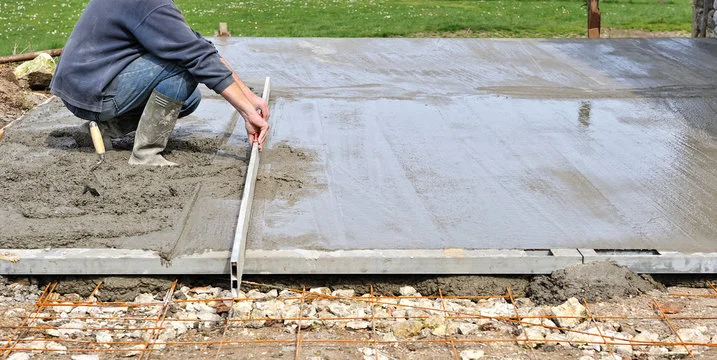
Affecting Factors That Can Drive Up the Concrete Slab Costs per Square Foot
Do you want to know how and which factors can drive up your concrete slab cost? Yes! Then read this blog carefully and follow the expert’s instructions. Several factors influence slab cost, including labor, materials, thickness, and finishes. We need to clearly find the accuracy of these factors to save money.
Labor Cost
Labor cost is 40% to 50% of your full project cost, so this is an essential and huge part of the project. In today’s markets, the concrete slab installer charges $3 – $5 per sq ft, but this depends on the project location and complexity. Industrial project cost is up, and a few extra works and requirements also cost more, like finishing, pouring, and cleaning. Skilled worker can also charge more according to their skills.
Thickness
Most clients use 4 to 6 inches thick slabs, but sometimes they require a thicker slab up to 8 inches. That thickness can cost more due to extra labor and raw material, which can increase the total project cost.
| Thickness in Inches | Rates |
| 2 | $4-$6 |
| 4 | $6 – $8 |
| 6 | $8 – $10 |
| 8 | $10 – $12 |
Material and Equipment Cost
Material is an important factor that can account for 50- 60 % cost of the total project cost, and it costs 50$ per square ft. Material can vary due to fluctuating prices and a shortage of materials. In this, we include equipment costs and rental material costs, such as padding. Material selection depends on the client’s requirements and needs, which will drive up your material cost. Additionally, slab thickness is crucial for purchasing accurate material quantities, as it can prevent both over- and under-ordering.
Concrete Quality
The quality of the concrete directly affects the cost of the slab. Concrete graded use from scale M5 to M70, and mostly use M10 to M25 grade concrete for household use because of its durability and cost-effectiveness.
Site Preparation
Before the start of the project or concrete, you need to level and clear the site area. Site preparation work costs $1-$3 per sq ft and helps prevent cracking, water pooling, and sinking. Getting site preparation is a critical investment that not only prevents you from issues but also increases your project’s lifespan and slab strength.
Finishes
Finishes are the client’s choice because the slabs look plain. If you need basic finishes, it will cost normally, and if you want stronger, then their stamped cost will be between $8-$20 per sq ft, and polishing range is between $ 3-$15 per sq ft.
About the Cost of a Concrete Slab Project
The cost of a concrete project depends on the project type and square feet. This cost also depends on project thickness and the client’s requirements. Prices can range from $4 to $28 per square foot.
Shed Slab
Mostly clients build sheds with a 4-inch thickness, and it will cost $600-$4800. It will depend on the slab size, and if clients require more finishing work, then it will be added to this money. Small sheds cost between $600 and $800 for 100 sq ft and are used for huts, sheds, and workshops.
Patio Slab
A patio slab is used for outdoor sitting areas, and it is mostly 12×12 ft. It will cost $800-$1300. Buts depend on the client’s need because most clients use sealers to protect from harsh weather conditions, and it will cost more.
Garage Floor
Most garage floors have heavy machinery, which is why contractors require more reinforcement or barriers to get more durability. It ranges from 400 sq ft to 576 sq ft, with a corresponding cost range of $2,400 to $6,900. Also, it depends on the client’s needs. If clients require more epoxy finish, then it requires more money.
Driveway Slab
Driveway slabs are tailored to the client’s specific needs. Whether it’s required for a single car, a double car, or a triple car. It depends on their sq ft. In 2025, driveway slabs cost $2,400-$13,000 for 400 sq ft to 800 sq ft, but if clients need more durability or a broom texture, then it will consume more.
RV Pad
The RV pad requires strong reinforcement and site preparation, which is why the RV pad is thicker. These types of RV pads cost 1200$ to 8400$ for 200-400 sq ft. Additionally, this slab requires strong site preparation, which will increase the cost.
| Pour Type | Area | Average cost |
| Shed foundation | 100 – 400 | $600 – $4,800 |
| Patio | 200 – 400 | $1,000 – $6,000 |
| Garage floor | 400 – 576 | $2,400 – $6,900 |
| Concrete driveway | 400 – 800 | $2,400 – $13,000 |
| RV pad | 200 – 700 | $1,200 – $8,400 |
| Mobile home slab | 600 – 1,600 | $3,600 – $19,200 |
| Foundation | 800 – 2,400 | $4,000 – $33,600 |
What Are the Types Of Concrete Slabs?
On-Grade Slab
An on-grade slab poured directly on the ground, that’s why it’s called a ground slab. Its thickness is 4-6 inches and is used for all residential building floors, garages, shades, patios, and driveways. On-grade slabs are the cheapest and fastest to construct, but are best for flooded and cracking areas.
Precast Slab
It is heavy slabs and needs special cranes and heavy machinery to move. Also, precast slabs are used for all types of commercial construction, tunnels, and bridges for fast installation. Its transport cost is very high due to its heavier property and the special crane needed to transport it.
Post-Tensioned Slab
These slabs use steel cable to increase their strength and tension. Post-tensioned slab is used for multi-story buildings, parking, and heavy loads. It is powerful, but its installation cost is high and requires specially skilled engineers.
Flat Slab
If any building has no beams, then a flat slab is used to support the columns, and it is used for shopping malls, offices, parking, and commercial buildings. With the help of a flat slab, we can easily reduce the floor-to-floor height and install it more easily.
Notable: A flat slab is not suitable for heavier loads, so be aware.
One-Way Slab
A way slab is used to transfer the load from one side and is typically used in small rooms and corridors. Also, it is very simple, easy to design, and cost-effective, but it can’t bear a heavy load.
High Strength Two-Way Slab
If you are looking to support the four sides of the slab, then use a two-way slab. It can be used in halls, auditoriums, and commercial buildings, and it can easily distribute the load equally on 4 sides.
Composite Slab
A composite slab is made up of two composite materials, such as steel and concrete, and is used in commercial buildings and industrial floors to effectively bear heavy loads. These slabs are more costly than standard slabs, but they are easy to install.
| Slab Types | Strength | Cost |
| On-Grade Slab | Medium | Low |
| Hanging Slab | High | High |
| Precast Slab | High | High |
| High-Tensioned | Very High | High |
| Flat Slab | Medium | Medium |
| One-Way Slab | Medium | Low |
| Composite Slab | High | High |
Various Types of Concrete
In today’s world, most elements used for construction are concrete, but concrete is not a single material; it comes in different types according to their strength, size, durability, and purpose. Now we are discussing their standard and most usable types.
Plane Concrete
Plane concrete made of gravel and cement is usually used for residential buildings, but it cannot take heavy loads, and it is also used for floors, side boxes, basements, and driveways.
Reinforced Concrete
Rainforest concrete is usually used for heavy loads, and this concrete is used for multi-apartment building foundations and bridges. It uses steel bars and wires to make it strong.
Prestressed Concrete
Most countries are now using prestressed concrete because it uses stretched steel cable before the pouring. And when it comes to harder materials, that’s why their strength is particularly advantageous; it is used for long-distance bridges, large buildings, commercial units, and flyovers.
Lightweight Concrete
Where we need lightweight concrete, we use it because it uses light materials like clay and pumice. It is mostly used for roof blocks and floors, where less weight is essential for building.
High-Strength Concrete
If you need a high-tall structure, such as a skyscraper, then you need high-strength concrete because it can handle a large amount of pressure, due to the highest cement value.
Mix Concrete
Mixed concrete is delivered by trucks, and it saves contractors time and money and also saves their precious minds, which is used in all commercial, industrial, and residential projects in 2025.
Self-Compacting Concrete
Self-compacting concrete is used where different shapes and pillars are needed, so this type of concrete does not require any vibration. Its flow is very easy to make construction, and is used in difficult areas to make construction easy.
Sprayed Concrete
Separate concrete is used in the construction of floors, swimming pools, walls, and building roofs.
Fiber Concrete
Fiber-mixed concrete is used where extra strength is needed, and it prevents our slabs from water leakage and cracking. It is usually used in floors, slabs, and industrial buildings.
Now their PSI and strength are shown in the table below:
| Concrete Type | PSI(Rang) 2025 |
| Plain Concrete | 2,500 – 3,000 PSI |
| Reinforced Concrete | 3,000 – 5,000 PSI |
| Prestressed Concrete | 4,500 – 7,000 PSI |
| Lightweight Concrete | 2,000 – 3,500 PSI |
| High-Strength Concrete | 6,000 – 10,000+ PSI |
| Decorative Concrete | 3,000 – 4,500 PSI |
| Ready-Mix Concrete | 3,000 – 6,000 PSI |
| Self-Compacting Concrete (SCC) | 4,000 – 7,000 PSI |
| Sprayed Concrete | 4,000 – 6,000 PSI |
| Fiber-Reinforced Concrete | 4,000 – 7,000 PSI |
About Misinformation of Concrete Slabs
Misinformation leads to overruns in concrete slab costs, which exceed the budget, and creates frustration for contractors, homeowners, and engineers during the construction process. The following misinformation is presented, and you should address it before the project begins.
“Concrete Slab is Cheap Due to the Low Price of Concrete”
Most people think that the cost of the material for the slab is low, like gravel, water, sand, and cement. That’s why the price should also be very low, but in reality, if you want quality, it includes a gravel base, leveling, a metal or wooden hold, rubber, fiber, a pump for water, equipment, and, most importantly, labor costs. That’s why the final price is 3-4 times the raw material.
“Finish Work and Consume a Small Amount”
Most people think decorative finishing work costs a little extra, but it is a specialized skill that significantly adds to your project cost. Even basic gray concrete consumes 5$-7$ per sq ft, and if you do stamped work, it will consume 8$-20$ per sq ft. A polished or epoxy coating is more expensive than the others, consuming $10-$25 per sq ft.
Hence, the decoration of the finished work can double the cost of your project, so don’t think that it requires a huge amount of money.
“A Concrete Slab is a One-Time Cost”
Many people believe that a concrete slab incurs only a one-time cost, but in reality, a concrete slab is durable and requires maintenance and precautions to prevent water leakage. It should be secure our repair after 2 hours, 3 years, especially in grades and basements, so do not think about that it is only a one-time cost, don’t ignore their maintenance, it can reduce your slabs’ durability, it can be down after 42-100 years if you don’t maintain it properly, then their life span will be decreased.
Conclusion
In 2025, concrete slabs will be the most affordable foundation for your construction, whether you are planning commercial buildings, residential buildings, or a driveway, garage floor, patio, or any other slab project, depending on the raw material cost. Still, the actual price is more than its concrete factors, which directly affect the concrete slab cost, such as labor, decoration, finishes, reinforcement, slab thickness, and side preparation. These factors can change the overall price. Most people get misinformation about how concrete is cheap, but they don’t know the actual cost, and these unexpected expenses can drive up your project costs, and assumptions about these factors decrease your slab’s lifespan.. If you want your slab to be cost-effective, prevent these factors and cover it precisely to save more.
FAQs
Does that concrete slab construction help with structural durability?
The lifespan of a concrete slab is outstanding, and it is durable for 32-100 years. If it is installed properly and correctly. To get a long durability, you ned to avoid from few factors such as cracks, breakage, and weather changes. Contact the contractor to prevent them, and enjoy your long-lasting concrete slab.
How much maintenance is important for a concrete slab?
Maintenance is required for all projects, even in concrete slabs. Sometimes, cracks, water leakage, and weather conditions can easily damage your concrete slab, so proper maintenance and waterproofing are essential to maintain the concrete slab, and also it can provide you with a more durable ability.
Where can we use a concrete slab, and can I use it for a residential building?
A concrete slab is used for various purposes such as patios, driveways, residential buildings, commercial buildings, foundations, basements, garage floors, and others. It is also used to support building structures.
When did we need to change our concrete slab?
The concrete slab’s lifespan is long, but it can be replaced after 40 years. It can be decreased if you do not properly care for it. You need to prevent cracks and water leakage, and that will extend your slab’s life. Before then, you can maintain it easily.
How much time does it take for a concrete slab to dry after pouring?
Usually, it takes one to two days to try, but you can only walk on it. The concrete slab can be completely dry after 28 to 48 days. After one to two weeks, you can drive on it, so be careful for 28 to 48 days after loading.